

GETAWAYS • Brazil
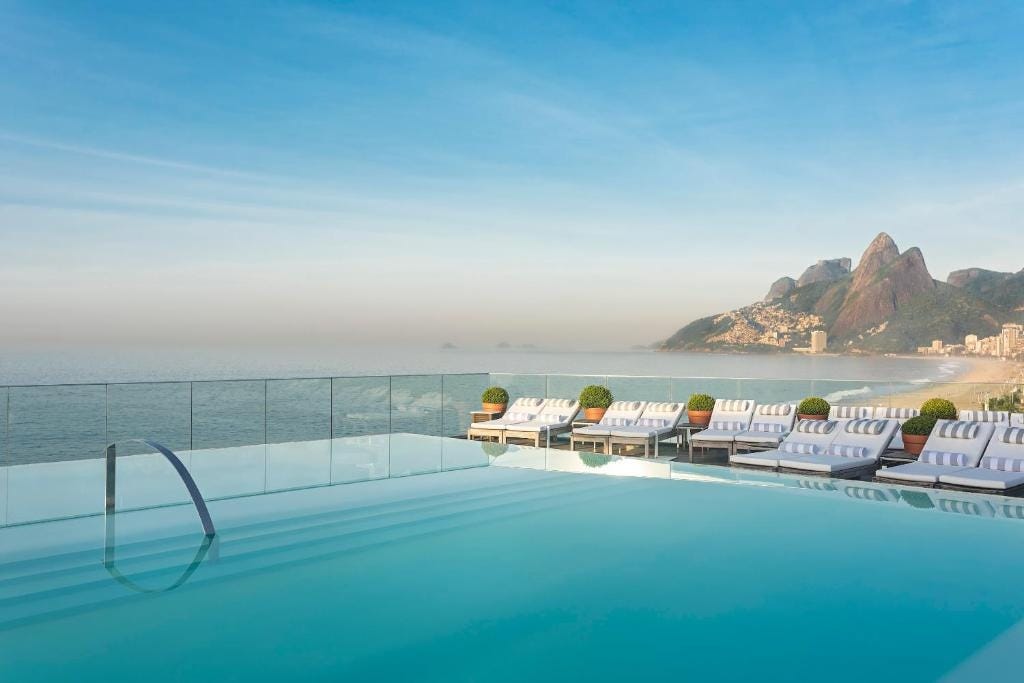
A modern counterpoint to Rio de Janeiro’s century-old Copacabana Palace (intel), Fasano Rio de Janeiro has all the makings of a classic. Built in 2007 with architecture and interiors by Philippe Starck, it cuts a modernist silhouette in dark wood and glass on a bend of famed Ipanema Beach — arguably the hotel’s greatest asset.
Compared to neighboring Copacabana Beach, I find Ipanema to have a more subdued locals’ vibe — yet with all the hallmarks that make Rio’s beaches vibrant and one-of-a-kind: beautiful people, in itty bitty bikinis, and vendors traipsing through the sand, selling everything from grilled queijo to canga beach blankets. Starck has taken maximum advantage of the views in his architectural lines. A sublime rooftop infinity pool puts you at eye level with the ocean and perfectly frames the iconic Dois Irmãos (Two Brothers) peaks. Here, passionfruit caipriñhas go down smooth and pair perfectly with a classic filet mignon sandwich at lunchtime.
For those familiar with Starck’s work at early aughts (now shuttered) hotspots, like the Hudson Hotel in New York City or the Delano (whose comeback is imminent) in Miami Beach, his playful, surreal touch is on full display, set against a minimalist, tropical modern backdrop. He favors dark, moody lighting, gleaming hardwood, amorphous mirrors, cushy jewel-toned sectional sofas, and abstract sculptures inspired by Dalí. At times, the design feels timeless; at others, it feels like time-traveling back to that era when Starck’s touch was ascendant. That’s not necessarily a bad thing, especially for someone like me, who has happy memories wrapped up in those times and places.
Rooms are transcendent. My deluxe oceanfront room was more long than wide, a linear design scheme that seamlessly flows out onto a spacious oceanfront balcony, decked out in dark hardwood with gorgeous, low-slung modernist wooden lounge chairs that evoked a sense of calm and relaxation. It was the perfect place to while away the morning with a coffee, gazing out at the ocean’s crashing waves and the Cagarras islands on the horizon.
The Fasano family’s hospitality legacy in Brazil spans more than a century, starting in São Paulo by way of Milan, with hotels and restaurants today across Brazil, Uruguay, and most recently, in New York City. At Fasano Rio, the restaurant Gero is named for Fasano’s fourth-generation hotelier and leans into Italian heritage with a menu designed to be eaten as a three-course prix-fixe with highlights like beef carpaccio, spaghetti puttanesca, a variety of risottos and roasted lamb. There’s also Fasano Caffe with indoor and outdoor seating for a gorgeous breakfast buffet.
I recently met Gero at the opening party for a new bar at the Fasano Restaurant New York in Midtown. He was dressed in his signature suit with a light sweater draped over his shoulders and dark-rimmed glasses for the look of a studious aesthete. I asked him, somewhat playfully, why someone should stay at Fasano Rio as opposed to, say, the more classic Copacabana Palace on their first trip to Rio. He mentioned his hotel’s rooftop pool for a full day of sun (as opposed to the courtyard setting at Copacabana), the ideal Ipanema location, and that, for some, luxury is found at a more intimate scale (89 rooms vs. Copacabana’s 240) with modern design.
Having checked into, and been thoroughly charmed, by both hotels, he articulated exactly what makes Fasano Rio unique in its way. –Shayne Benowitz
→ Fasano Rio de Janeiro (Rio de Janeiro, Brazil) • Avenida Vieira Souto, 80 • winter rates from $763/night.